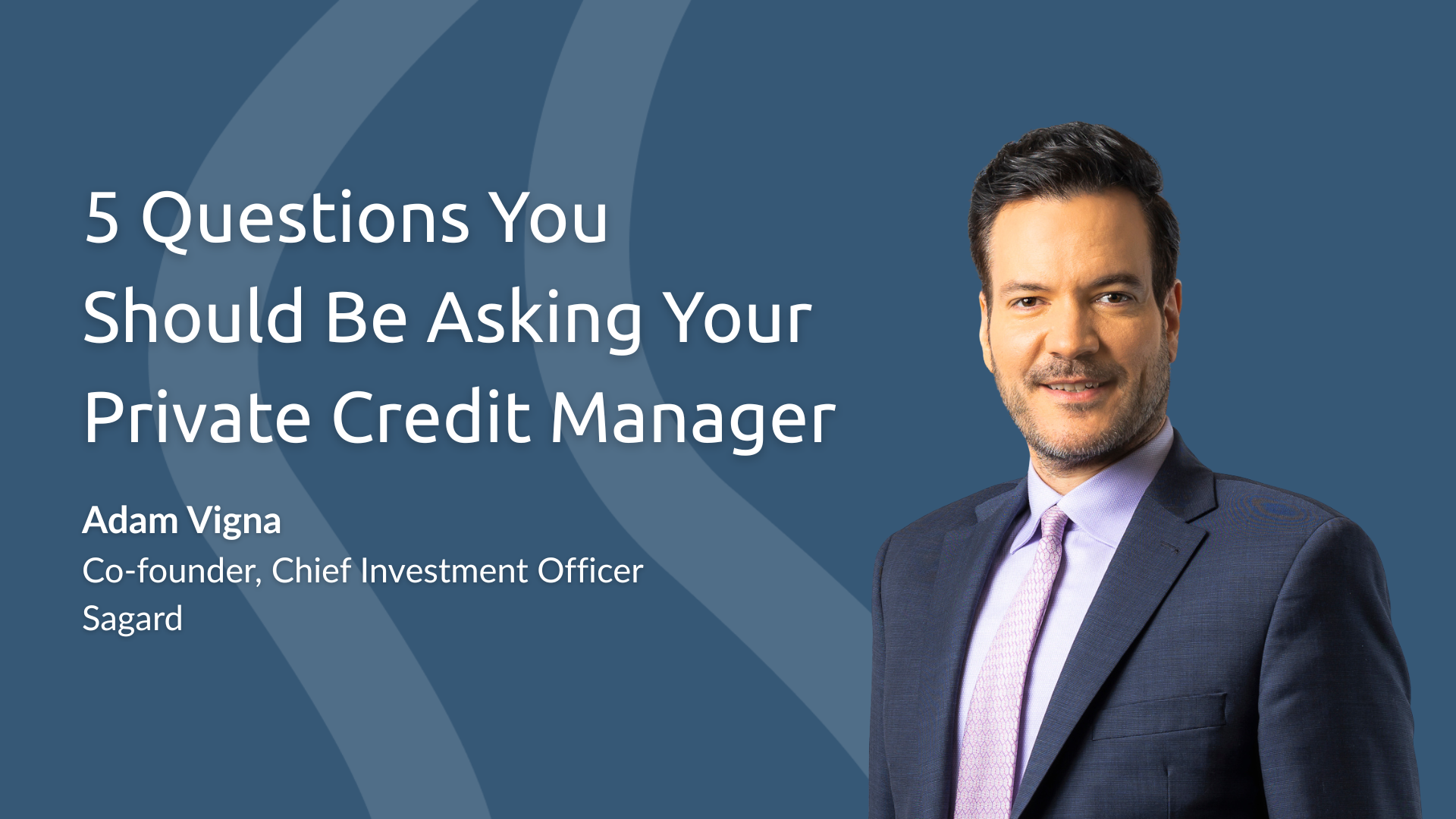

Adam Vigna
Co-founder, Chief Investment Officer
Sagard
Recent headlines about the private credit market have understandably prompted advisors and investors to take a closer look at how these portfolios are constructed, particularly when it comes to collateral quality, leverage, liquidity structures, and downside protection. In moments like this, it’s worth revisiting the fundamentals and focusing on the questions that matter most when evaluating a private credit manager.
With that in mind, here are five questions advisors are, and should, be asking about private credit strategies today, and how we approach them at Sagard. [Click each question to expand]
When evaluating private credit strategies, the starting point should be the underlying collateral and the recoverability of the loan.
At Sagard, we focus primarily on first-lien senior secured loans, which sit at the top of the capital structure and have priority on collateral. These loans are typically underwritten at conservative loan-to-value (LTV) levels of roughly 37–39%, with senior debt around 3.3x EBITDA.
We prioritize businesses with durable cash flow and tangible value that can be analyzed through a full cycle. In practice, that means being cautious about situations where value depends heavily on projected growth or multiple expansion rather than proven operating performance.In uncertain markets, collateral quality and underwriting discipline matter more than headline yield. Our approach is to think about recovery before we invest, not after.
Private credit is often described as relationship-driven lending, but the depth of those relationships can vary significantly across managers.
We do not view ourselves as passive capital. Many of the companies we lend to are founder-led or non-sponsored middle-market businesses, which gives us direct access to management teams and ownership groups.
That access is combined with structured reporting, regular dialogue with management, and strong maintenance covenants that provide formal touchpoints if performance changes.This combination of direct relationships and contractual protections allows us to identify potential issues early and address them constructively before they become larger problems.
Senior secured loans occupy the top position in the capital stack, which means they have priority on collateral in a downside scenario. This structural seniority can reduce loss severity if something goes wrong, but it does not eliminate default risk.
Balancing risk and return in private credit often comes down to structural discipline.
At Sagard, we prioritize structure over the highest yield. Stretching for incremental return by increasing leverage, weakening covenants, or moving down the capital structure can materially change the risk profile of a loan.
Our focus is on building the loan correctly from the outset — conservative leverage, strong documentation, and disciplined underwriting — with the goal of generating attractive risk-adjusted returns over time rather than chasing the highest headline yield in any given market.
A disciplined credit strategy plans for stress before it happens.
We monitor borrower performance continuously, and loans we originate include strong maintenance covenants, which create formal intervention rights if performance weakens. Recovery and downside scenarios are considered during the underwriting process, not only after a problem emerges.
Because much of our lending is non-sponsored, our primary relationship is directly with the borrower and ownership group rather than with a private equity sponsor. This dynamic often allows for earlier transparency and more direct dialogue if conditions change.
If credit quality deteriorates, we engage management early, rely on covenant protections where appropriate, and draw on the team’s experience navigating restructurings across cycles.Credit risk can never be eliminated entirely. The objective is to mitigate potential losses and preserve capital through thoughtful structuring and proactive engagement.
Liquidity is one of the most important structural considerations in private credit.
The Sagard Private Credit Fund is structured as an evergreen vehicle, offering monthly subscriptions and quarterly redemptions. To support that liquidity, we maintain a modest allocation — typically around 15–20% of the portfolio — in broadly syndicated loans (BSLs) that can be bought and sold.
That tradable sleeve helps provide liquidity, but it can introduce some mark-to-market volatility for that portion of the fund. By contrast, a purely private portfolio may allow for greater spread capture, but it offers less flexibility.
In our view, liquidity is a design decision, and it must be structurally supported to avoid mismatch risk. The more important question is not simply what premium an investor earns for giving up liquidity, but whether the fund’s structure supports resilience through a cycle.
Compensation for lower liquidity should reflect underwriting discipline, collateral quality, covenant strength, and overall portfolio construction, not just headline yield.
In the current environment, we are deliberately managing liquidity conservatively and reassessing that balance on an ongoing basis.
The Bottom Line
Private credit can offer attractive income and diversification benefits, but the details of how a portfolio is constructed matter greatly.
Asking the right questions about collateral, relationships with borrowers, capital structure, downside protection, and liquidity design can help investors better understand how a strategy may perform across different market environments.
Ultimately, resilient private credit portfolios are built not only on yield, but on disciplined underwriting, thoughtful structure, and a clear focus on risk management.
Our team is always happy to address your questions. Reach out to your Sagard relationship manager to learn more about our investing approach and the Sagard Private Credit Fund.
Acknowledgement and Disclaimers
The materials contained herein are for information purposes only and do not constitute an offer to sell or a solicitation of an offer to purchase any interest in any investment vehicles.
Statements contained herein reflect the subjective views and opinion of Sagard and may not be able to be independently verified. These materials are being provided solely for informational purposes and are not intended to be, and shall not be regarded or construed as, rendering accounting, business, financial, investment, legal, tax, or other professional advice or services, nor as a recommendation for a transaction or investment, including without limitation an offer to purchase, sell or hold any security investment, loan or other financial product or to enter into or arrange any type of transaction. This publication is not a substitute for such professional advice or services, nor should it be used as a basis for any decision or action that may affect your business. Before making any decision or taking any action that may affect your business, you should consult a qualified professional advisor. Sagard shall not be responsible for any loss sustained by any person who relies on this publication.
Like all investments, an investment in private markets involves the risk of loss. Investment products such as private market investments are designed only for sophisticated investors who can sustain the loss of their investment. Accordingly, such investment products are not suitable for all investors. Private market investments are not subject to the same or similar regulatory requirements as mutual funds or other more regulated collective investment vehicles.
Certain statements and certain of the information contained in these materials represents or is based upon “forward-looking” statements or information based on experience and expectations about these types of investments. The forward-looking statements in these materials include statements with respect to, among other things, projections, forecasts or estimates of cash flows, yields or returns, scenario analyses or proposed or expected portfolio composition and anticipated future events, performance or expectations. Forward-looking statements are inherently uncertain and are not guarantees of future performance and are subject to many risks, uncertainties and assumptions that are difficult to predict. No representation or warranty, express or implied, is made as to any forward-looking statements and information and no undue reliance should be placed on such forward-looking statements and information. Sagard has no obligation and does not undertake to revise or update these materials or any forward-looking statements set forth herein, except as required by law.
The information in the attached materials reflects the general intentions of Sagard. There can be no assurance that these intentions will not change or be adjusted to reflect the environment in which Sagard will operate.
Past performance and historic information is not necessarily indicative of future activities or returns, and there can be no assurance that comparable results will be achieved.
No securities commission or regulatory authority in Canada has in any way passed upon the merits of an investment in private markets or the accuracy or adequacy of the information or material contained herein or otherwise.
The information contained herein is in summary form for convenience of presentation. It is not complete and it should not be relied upon as such. Sagard makes no representation or warranty, express or implied, as to the accuracy or completeness of the information contained herein.
All information is presented as of March 2026 unless otherwise stated.
Sagard Holdings Manager (Canada) Inc. is registered as an exempt market dealer in the provinces of British Columbia, Alberta, Manitoba, Ontario, Quebec, and Nova Scotia. The Ontario Securities Commission is the Principal Regulator of Sagard Holdings Manager (Canada) Inc.